Payments Hub + Automatic Payments
Leading a strategic overhaul of partner payments so getting paid felt simpler, clearer, and less operationally painful.
Expedia’s partner base had expanded from large hotel chains to smaller properties and vacation rentals run by lean teams. But the finance experience still reflected internal systems more than partner workflows. Getting paid, understanding charges, and reconciling bookings required too much effort.
My role as lead UX designer was to help turn a complicated finance surface into a clearer partner experience: understand the pain, align stakeholders, create a north-star direction, and then bring the work back into an achievable MVP.
Product question: How do we help partners spend less time trying to get paid and more time running their business?
What made it hard
Navigation had grown around internal structures, redundant actions, finance terminology, and technical constraints.
Partners needed simpler explanations of charges, payouts, invoices, and what action they were expected to take.
Lack of in-context help and unclear workflows contributed to avoidable support and finance contact volume.
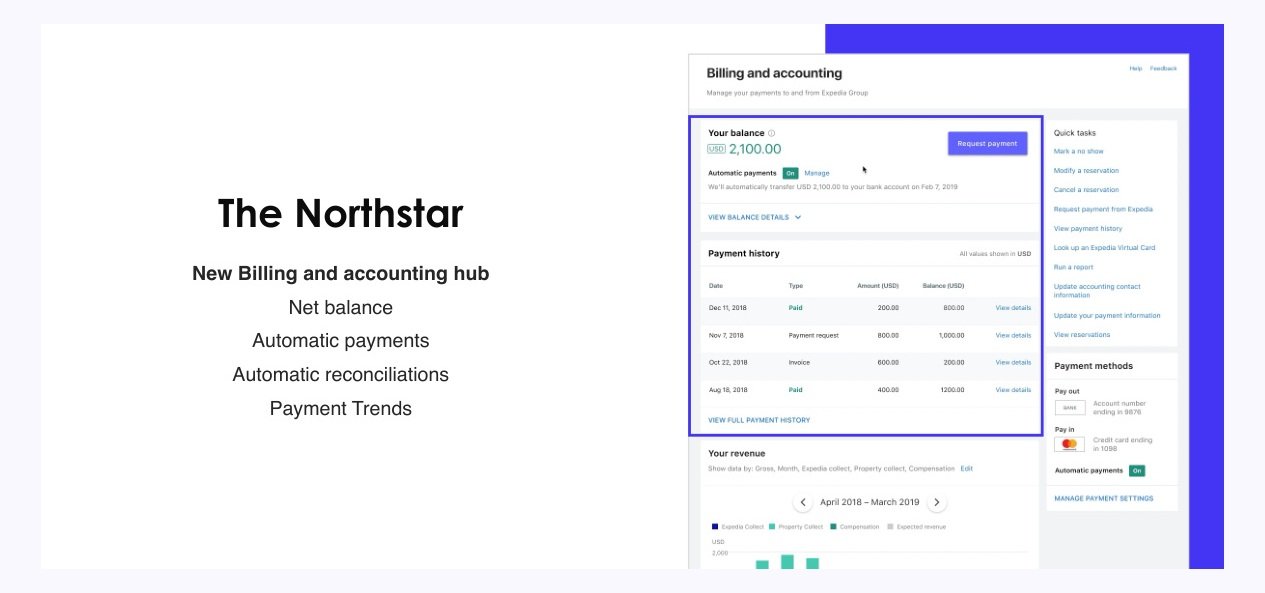
The questions that moved us from strategy to MVP
From design swarm to delivery sprint
We used a two-part process: a design swarm to explore the north-star without over-indexing on current constraints, then a focused design sprint to define scope, prototype quickly, and collect feedback.
That helped the team move from broad finance pain points into a practical delivery path: simplified terminology, recent invoices and payouts, quick tasks, help content, context based on payment method, and personalization for newly onboarded partners.
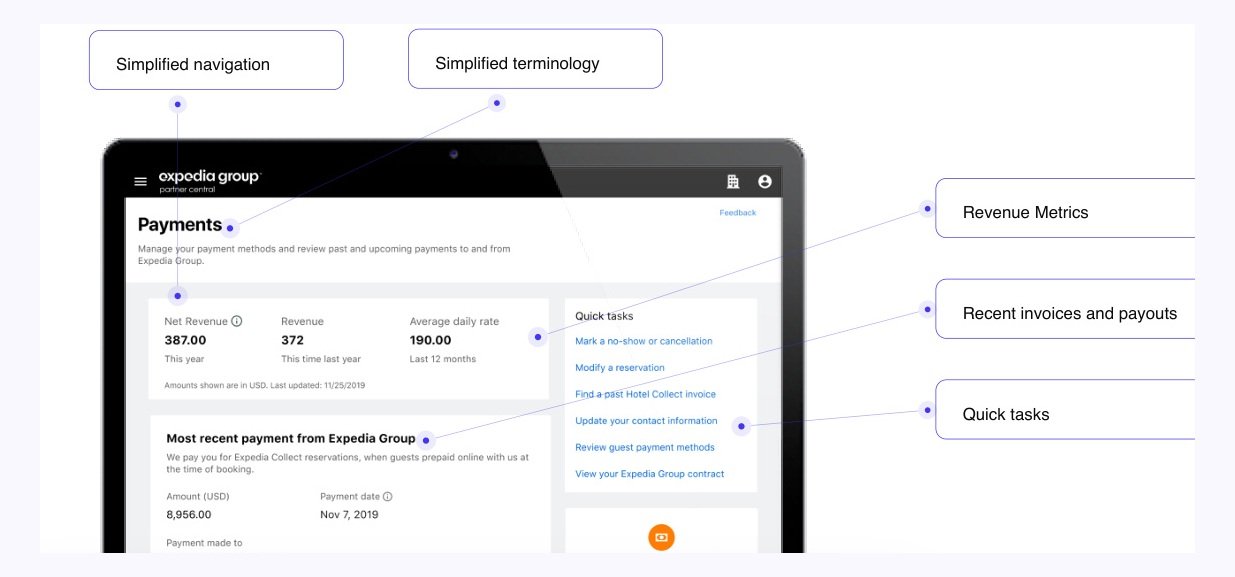
Used interviews, system mapping, and competitive teardown to understand the real workflow.
Helped partners and stakeholders see what a simpler finance hub could become.
Translated ambition into modules that could be launched and measured.
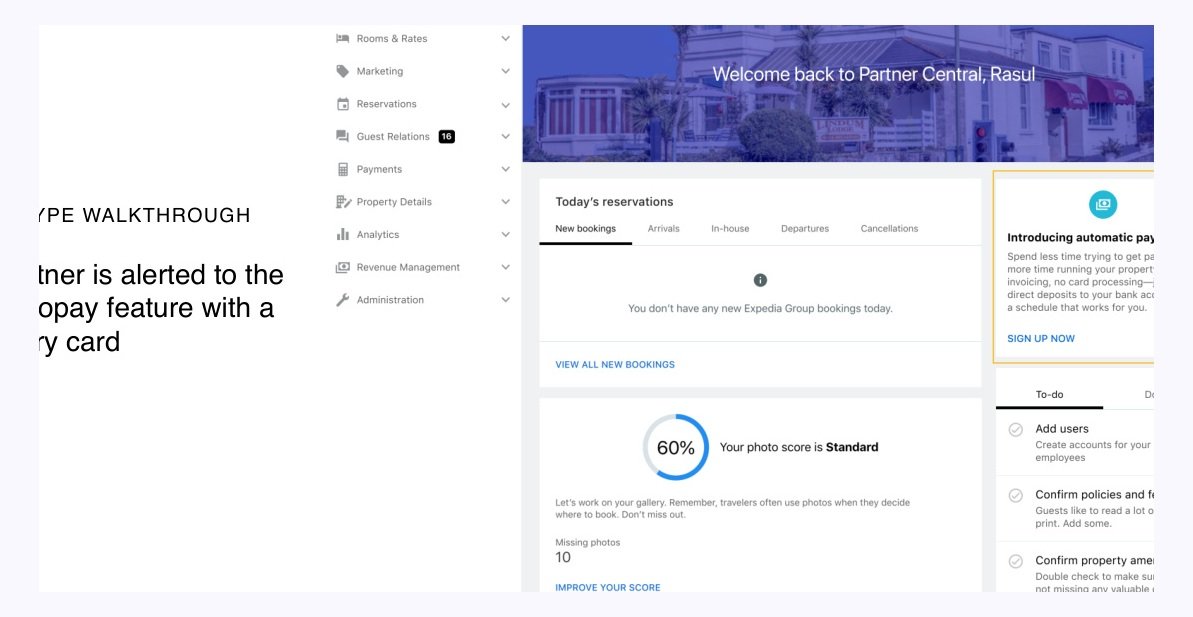
Tested the automatic payments flow with small and medium properties before launch.
The leadership lesson was that trust in a payment experience is built through clarity: plain language, visible status, fewer manual steps, and enough context to know what happens next.
Impact
The work reframed partner payments from a fragmented finance task into a clearer management experience.
Automatic Payments launched in May 2020; the original portfolio deck noted 30% signup among partners with fewer than 20 rooms within one month.
The experience reduced ambiguity around payouts, invoices, recent activity, payment method context, and what partners needed to do next.
The team had clearer success measures across engagement, partner satisfaction, operations contact volume, handle time, and finance case volume.
Learnings
In payments, trust is not only visual polish. It comes from plain language, predictable status, and fewer manual steps.
The design swarm created ambition, but the sprint helped the team decide what could be built, tested, and learned from first.
The strongest design opportunities came from reducing work for smaller properties that did not have large finance or operations teams.